QQSL Academy
RFI-001 Understanding RFI
Understanding RFI
Understanding RFI
1 lessons in this section
QSL Academy • Introduction To RFI > RFI-001 – Understanding RFI
RFI-001-001 – What Is RFI?
Introduction
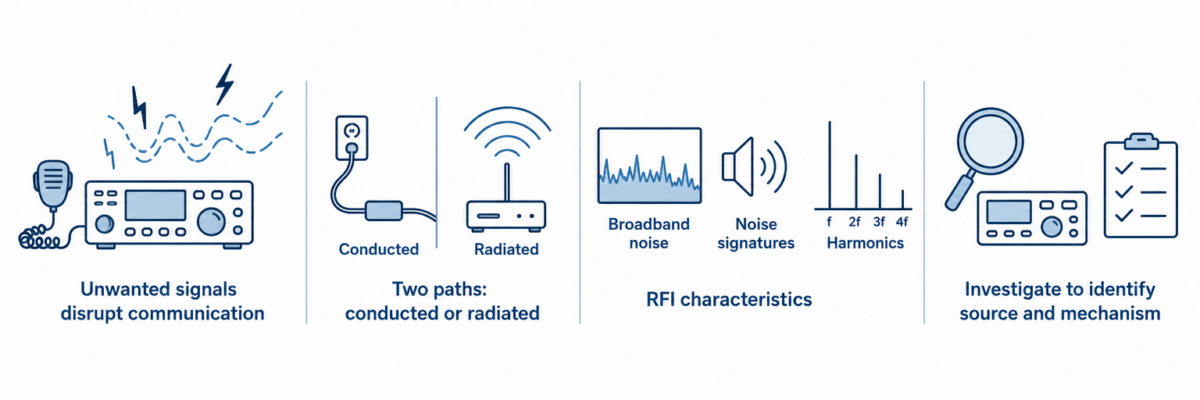
Understanding Radio Frequency Interference is fundamental for anyone involved in amateur radio. Interference can disrupt communication by introducing unwanted signals that obscure or distort transmissions and reception. This lesson explains what RFI is, the forms it takes, its characteristics, and the principles behind diagnosing and mitigating it.What Is Radio Frequency Interference (RFI)?
The term RFI stands for Radio Frequency Interference. It refers to undesired radio-frequency energy that disrupts either the reception or transmission of signals. Such interference can come from both natural sources, like solar activity, and many man-made sources, including electronic devices and electrical equipment. Amateur radio operators should be aware and recognize RFI because it directly affects their ability to communicate effectively. Radio frequency interference is best described as An unwanted signal that disrupts communications. This disruption may take the form of reduced clarity, masking of desired signals, or additional noise that diminishes the quality of transmissions.Related Questions: RFI-001-001-001 • RFI-001-001-002
Types and Mechanisms of RFI
RFI can reach radio equipment primarily by two paths: conducted or radiated interference.Conducted Interference
Interference carried through electrical conductors is known as conducted interference. This form of interference travels along physical wiring, such as power lines or interconnecting cables. Because it follows a physical path, operators can often locate the interference by tracing conductors connected to the affected equipment.Radiated Interference
On the other hand, Interference transmitted through the air is called radiated interference. It travels as electromagnetic waves through space and can be generated unintentionally by various electronic devices and industrial machinery. Radiated interference is not limited to physical connections, making it sometimes harder to pinpoint. It is crucial To determine the proper suppression method by first identifying whether interference is conducted or radiated. Conducted interference often requires filters or isolators installed in wiring, while radiated interference may be reduced by shielding, relocating equipment, or modifying antennas to reduce susceptibility.Related Questions: RFI-001-001-003 • RFI-001-001-004 • RFI-001-001-005
Characteristics of RFI and Patterns
Broadband interference is a common and particularly disruptive form of RFI. A typical symptom of broadband interference is Noise across many frequencies. Operators may hear a constant buzzing, hissing, or raspy sound spanning multiple bands, making it different from narrowband interference affecting only one frequency. In fact, broadband noise can be defined as Noise spread across many frequencies. This means it affects a wide range of frequencies rather than a sharp, isolated frequency. Such interference can degrade many amateur bands at once, especially if the source of interference is strong or close. Each interference source often produces a unique noise pattern or signature that helps in its identification. This concept is known as a noise signature: A characteristic pattern produced by a noise source. These signatures may be heard as distinct sounds or visible as specific patterns on a spectrum display, aiding in diagnosing the interference's cause. Another important concept related to identifying interference sources is that of harmonics. A harmonic is A multiple of a fundamental frequency. Harmonics occur when signals are generated at frequencies that are integer multiples of a lower base frequency. Recognizing harmonics can assist amateur operators in tracing interference back to its source, especially when caused by electronic devices or transmitters emitting signals beyond their primary frequency.Related Questions: RFI-001-001-006 • RFI-001-001-007 • RFI-001-001-008 • RFI-001-001-009
Approach to RFI Investigation
The first step in resolving RFI problems is a careful diagnostic phase. The primary goal during this phase is to Identify the source and mechanism of interference. By understanding where the interference originates and how it reaches the affected equipment, amateurs can apply the most effective suppression techniques. Accurate diagnosis lays the groundwork for successful mitigation and improved radio communication.Related Question: RFI-001-001-010
What Is RFI?
RFI-001-001
10Questions
70%Passing score
—Time limit
Submit each answer to receive feedback, then continue to the next question.
Question 1 of 10
RFI-001-001-001 What does the term RFI stand for?
Question 2 of 10
RFI-001-001-002 Which statement best describes radio frequency interference?
Question 3 of 10
RFI-001-001-003 What is meant by conducted interference?
Question 4 of 10
RFI-001-001-004 What is radiated interference?
Question 5 of 10
RFI-001-001-005 Why is it important to identify whether interference is conducted or radiated?
Question 6 of 10
RFI-001-001-006 What is a common symptom of broadband interference?
Question 7 of 10
RFI-001-001-007 What is meant by broadband noise?
Question 8 of 10
RFI-001-001-008 What is meant by a noise signature?
Question 9 of 10
RFI-001-001-009 What is a harmonic?
Question 10 of 10
RFI-001-001-010 What is the primary goal of the diagnostic phase of an RFI investigation?
✓
What Is RFI? Results
0 / 10
0% · Not completed
0Correct
0Incorrect
0%Best score
0%Latest score